




Three quotes land for the same translation job. One is a few hundred euros, one is double that, the third is several thousand.
The word count is identical on all three. Nothing on the page tells you why they differ, or which one you will regret.
That happens because translation has no universal rate card. The language services industry was worth around USD 71.7 billion in 2024 and an estimated USD 75.7 billion in 2025, and it stays highly fragmented: the 100 largest suppliers held roughly a fifth of the market in 2023, and most providers earn under USD 10 million a year (Nimdzi 100, 2025). Thousands of suppliers, each with their own model, produce the spread you see in your inbox.
This article gives you a real per-word range for 2026, explains the pricing models behind a quote, works through a single project costed three ways, and gives you a way to read any quote line by line. As a language service provider (LSP), we have priced translation work since 1990, so the examples come from how quotes are actually built.
TL;DR
|
How much does professional translation cost in 2026?
Professional human translation costs roughly USD 0.10 to 0.30 per word in 2026, or about EUR 0.09 to 0.28, with specialist and rare-language work at the top of that band and high-volume post-edited machine translation below it. These are illustrative ranges; your actual rate depends on the factors below.
Three things shape every translation cost:
- Language pair: common pairs such as English to Spanish cost less than English to Danish, because the pool of qualified linguists is larger.
- Content type: a product listing is cheaper than a regulated medical document, which needs a specialist linguist and extra checking.
- Quality level: a single-pass translation costs less than full translation, editing, and proofreading by independent linguists.
Because thousands of suppliers each set their own rates, published figures vary widely. The ranges in the table below are drawn from 2026 supplier and platform price guides and are meant as a starting point for budgeting, not a fixed price.
| Content type | Typical model | Illustrative range (per source word) |
|---|---|---|
| General business content | per word, TEP | USD 0.10–0.16 / EUR 0.09–0.15 |
| Specialist (medical, legal, technical) | per word, TEP plus specialist | USD 0.15–0.30 / EUR 0.14–0.28 |
| Transcreation (campaigns, taglines) | per hour or per project | from USD 45/hour or project-based |
| MTPE (high-volume, lower-stakes) | per word | USD 0.05–0.12 / EUR 0.05–0.11 |
| Certified / sworn (EU submissions) | per page or per document | from EUR 30–50 per page |
Ranges are illustrative, built from 2026 published price guides (Smartling, GTS, Convey911). A real quote depends on your files, languages, and reuse.
The pricing models, and which one you are being quoted
Most translation is priced per word. The alternatives are per hour, per project, and per character for some Asian languages, and each suits a different kind of work. Knowing which model sits behind a quote is the first step to comparing two of them fairly.
Per-word pricing, and source versus target words
Per-word pricing is the default for countable content such as manuals, websites, and product copy, because it is simple to budget and easy to check. One detail to watch: some suppliers count source words (the original) and some count target words (the translation).
Target-language expansion matters here. A German or Finnish translation usually runs longer than its English source, so a target-word quote for those languages can come in higher than a source-word quote for the same job. Ask which one a quote uses before you compare two suppliers.
Per-hour and per-project pricing
Hourly pricing fits work where word count does not reflect the effort, such as transcreation, heavy cultural adaptation, or layout-bound jobs. A flat project fee with a minimum charge fits small, well-defined deliverables.
Minimum charges explain why a 100-word job rarely costs the price of 100 words. A supplier still has to open the project, assign a linguist, run quality checks, and deliver, and those fixed steps cost the same whether the file holds 100 words or 1,000.
What MTPE changes about the price
Machine translation post-editing (MTPE) costs less than full human translation for suitable content, because a linguist edits a machine-generated first pass rather than translating from scratch. It fits high-volume, lower-stakes material such as internal documentation and large product catalogues.
It does not fit published, regulated, or brand-critical content, where a missed nuance carries real cost. Our view on machine translation post-editing is that it earns its place by content type, paired with human review whenever quality matters.
| Model | How it is calculated | Best for | Budgeting note |
|---|---|---|---|
| Per word | rate × word count | manuals, websites, product copy | most predictable; check source vs target |
| Per hour | rate × hours | transcreation, adaptation, layout work | less predictable; agree a cap |
| Per project | flat fee | small, fixed deliverables | watch the minimum charge |
| MTPE per word | discounted per-word rate | high-volume, lower-stakes content | cheaper, not for published or regulated work |
What drives the price up or down
Seven factors move a translation quote: language pair, subject matter, file format, turnaround, quality level, volume, and how much repeated content you have. Each one is something you can plan around once you know it is there.
Language pair and the Nordic premium
Common pairs such as English to Spanish, French, or German sit at the lower end, while Nordic and rare languages cost more because fewer qualified linguists are available. Published 2026 rates put English to Latin-American Spanish near USD 0.08 per word and English to the Nordic languages at roughly USD 0.19 to 0.25 (GTS, 2026).
Picture a retailer localising one campaign into Spanish and into Danish. The word count is identical, but the Danish line on the quote comes in noticeably higher, and that gap is supply, not padding.
Subject matter and specialist expertise
Specialist content costs around 50 to 100 percent more than general business text (GTS, 2026), because it needs a linguist with domain knowledge and additional quality checks. A regulated document carries liability that a marketing email does not.
This is where work flows to specialists in medical translation or technical translation, and where the premium buys accuracy that is cheaper than a regulatory rejection later.
File format and layout
Clean, editable files (Word, Excel, or XLIFF) cost less than locked PDFs, scans, or InDesign files that have to be extracted and rebuilt. The same 2,000 words cost more trapped in a locked brochure than sitting in a Word document.
Layout rebuilding (DTP) is a separate line on a complete quote. When it is missing, the cost has either been left out or hidden, and you will meet it later.
Turnaround and rush fees
Standard turnaround is the cheapest option; rush work runs roughly 25 to 100 percent more (GTS and Convey911, 2026). Speed, cost, and quality pull against each other, so a tight deadline usually shows up as a surcharge or as a quality risk.
| Factor | Direction | Typical effect | Why |
|---|---|---|---|
| Rare / Nordic language pair | up | +50–150% vs common pairs | fewer qualified linguists |
| Specialist subject matter | up | +50–100% | domain expertise and extra QA |
| Locked PDF / scan / InDesign | up | added handling and DTP | text extraction and rebuild |
| Rush turnaround | up | +25–100% | out-of-hours and reshuffled schedules |
| High repetition / reuse | down | discounted bands | translation memory reuse |
How to read a translation quote, and where the cost actually sits
A clear quote breaks the price into word bands by how much of the content is genuinely new. New words cost the full rate; content that matches something already translated costs less, and the closer the match, the bigger the discount. Reading those bands is how you tell what you are really paying for.
This is translation memory at work. Each segment is graded against everything translated for you before, then priced by how close the match is. The industry uses a fairly standard ruler.
| Band on the quote | What it means | Illustrative share of new-word rate |
|---|---|---|
| No match | new content, never translated for you | 100% |
| Fuzzy 75–84% | loosely similar to a stored segment | around 60–70% |
| Fuzzy 85–99% | closely similar | around 50–60% |
| 100% match | identical to a stored segment | around 30% |
| Repetitions | repeats within the same project or batch | around 30% |
Discount bands are illustrative, based on common industry practice (GTS, 2026).
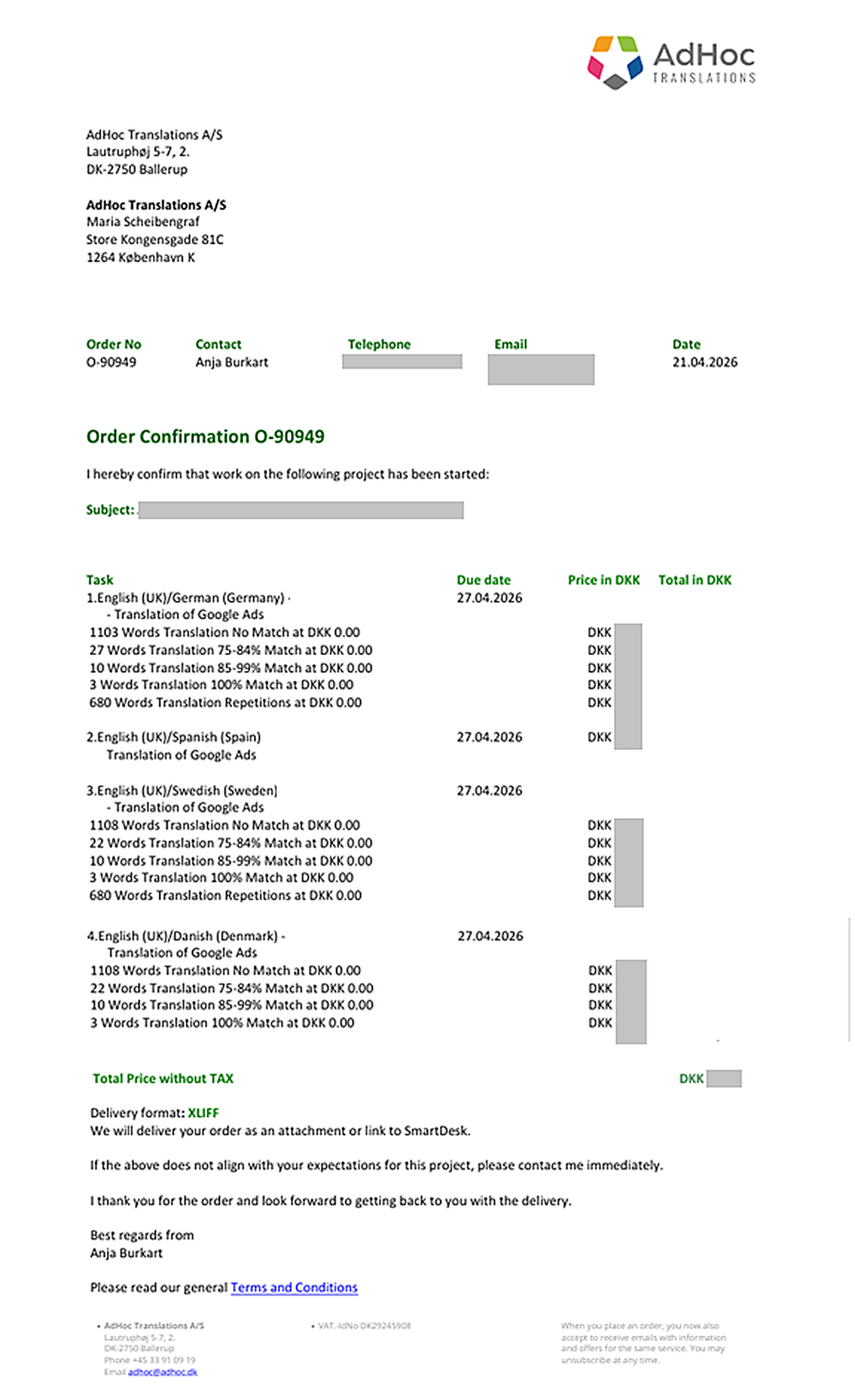
Here is what that looks like on a real document. The order confirmation below is one of ours, redacted, for a set of Google Ads localised from English into German, Spanish, Swedish, and Danish.
| Reading a real AdHoc Translations order confirmation (O-90949, redacted) Each language is itemised into the same bands. The German line, for example, shows around 1,103 new words, then 27 words at a 75–84% match, 10 at 85–99%, 3 at a 100% match, and 680 repetitions. The Swedish and Danish lines break down the same way. Read it band by band. The 680 repetitions are lines that recur across the ad set, so you are not charged the full rate to translate them again. The 100% and fuzzy matches are content already in your memory from earlier work. Only the no-match words are billed at the full rate. The point is that the breakdown is visible. You can see exactly what is new, what is discounted, and why, rather than being handed one round number. Figures here are illustrative. |
A quote that shows these bands is doing you a favour, because it tells you where the cost comes from and what reuse is saving you. Our our SmartDesk customer portal records each project, grows the memory, and reports the bands back to you, so the saving is documented rather than promised. The more you translate with one supplier, the larger the discounted share becomes.
The bands tell you how the words are priced. Three more questions tell you whether the rate covers the work you actually need:
- Does the rate include an independent second linguist checking the translation, or is it a single pass? A single pass is cheaper and fine for low-stakes content, as long as you know that is what you are buying.
- How is repeated and previously translated content priced, and will earlier projects feed the memory? A supplier with no memory discount is charging you full rate for work you may already own.
- Is formatting or layout rebuilding included, especially for PDFs, InDesign, or anything with graphics? This is the line most often left off until the invoice.
A worked example: the same project, costed three ways
The same 10,000-word project can range from a few hundred to several thousand euros, depending on the quality tier and the language pair. The table below works it through using the illustrative ranges already established.
| Approach | EN → Spanish (illustrative) | EN → Danish (illustrative) | Fit |
|---|---|---|---|
| Human TEP | ~EUR 1,000–1,400 | ~EUR 1,800–2,500 | published, brand, regulated |
| MTPE | ~EUR 500–800 | ~EUR 900–1,300 | high-volume, lower-stakes |
| Machine only | platform fee | platform fee | gist and internal reference only |
These totals are illustrative, built from the public benchmark ranges above, and are not an AdHoc Translations quote. Two things move them in practice.
The Danish column runs higher on the same word count, because of the language pair. A project with a large repeated share, like the order confirmation above with around 680 repetitions per language, drops below the human-TEP figures once memory discounts apply.
The cost that never appears on the quote
The largest translation cost is often invisible on the quote: the hours your own team spends fixing, checking, and re-commissioning work that was not right the first time. Around 60 percent of businesses report spending more correcting poor translation than they would have spent doing it well (Convey911, 2026).
When you compare quotes, weigh the costs that sit on your side of the line:
- Internal review hours, because your staff time has a real cost when they re-check weak output.
- Rework and re-translation, when the first delivery misses the brief and has to be redone.
- Project-management overhead, the chasing and clarifying you absorb when a supplier creates admin instead of removing it.
- Inconsistency across markets, when no shared memory or termbase keeps terminology aligned, and each market drifts.
- Re-translation of old content, when assets are not reused and you pay full price again for lines you already own.
Certified and sworn translation for EU submissions
Certified and sworn translations are priced differently, usually per page or per document rather than per word, because they carry legal weight and a formal statement or stamp. Expect figures from around EUR 30 to 50 per page, depending on the country and document.
They apply when an authority, court, or regulator requires them, for example company filings or regulatory submissions across several markets. For a business submitting in multiple countries, the practical questions are which markets require certification, whether VAT applies, and how the supplier handles each country’s rules.
How we approach translation pricing at AdHoc Translations
We price transparently: every quote itemises new words, fuzzy and 100% matches, and repetitions, so you can see what you are paying full rate for and what memory has discounted. The order confirmation described earlier is a real example of that breakdown.
We have priced and run translation work since 1990, with 5,500+ linguists working into their native language across 99+ languages, and offices across Northern and Western Europe, India, and the US. We lean on people, process, and technology to keep that pricing predictable.
A few things keep the cost legible and falling over time:
- we hold ISO 17100 and ISO 18587 certification, so independent revision and qualified post-editing are built into the process, not added as extras;
- our project teams and linguists stay with each account, which keeps terminology consistent and grows the memory; and
- our reporting shows the volume, the memory savings, and the cost per language in one place
If you would like to see how your current translation spend breaks down, or how a switch in supplier would look in practice, book a workflow review.
Frequently asked questions about translation costs
How much does it cost to translate one page?
A standard page runs about 250 words, so a per-page figure is roughly the per-word rate times 250, plus any minimum charge. At an illustrative EUR 0.12 per word, that is around EUR 30 for general content, before any memory discount or certification. Certified pages are priced separately, often from EUR 30 to 50 each.
Why is professional translation so expensive compared with machine translation?
You are paying for a qualified linguist plus independent revision, not just word conversion. A professional workflow catches meaning errors, terminology drift, and cultural mismatches that raw machine output misses. Machine translation or MTPE is the cheaper route for high-volume, lower-stakes content, and the right choice there; full human translation is for content where a mistake carries real cost.
How can I reduce translation costs without losing quality?
Several levers help, and none of them cut corners on the linguists. Sending clean, editable files keeps spend off text extraction, while planning ahead avoids rush fees. Reusing translation memory and termbases discounts repeated content, and batching jobs together rather than sending many small requests can qualify you for volume pricing.
What is a translation memory discount?
It is the reduced rate you pay on content that matches something already translated. Identical segments (100% matches) and repetitions are usually charged at around 30 percent of the new-word rate, and fuzzy matches fall between that and full price. The discount grows as your stored content grows, so the effective rate falls the longer you work with one supplier.
Is per-word or per-hour pricing better?
Per word is better for countable content such as manuals, websites, and product copy, because it is predictable and easy to check. Per hour is better for transcreation and heavy adaptation, where word count does not reflect the effort. The model should match the work, so ask which one a quote uses before comparing two suppliers.
Does a cheaper quote ever cost more in the end?
Yes, when revision, formatting, or project management are excluded and surface later as rework or internal review time. A low headline rate that omits independent revision often means you pay again to fix the output. Compare quotes on what is included, not on the per-word figure alone.
Sources
- Nimdzi Insights. The 2025 Nimdzi 100. Language services industry size estimates and market fragmentation, 2024–2025. nimdzi.com.
- Smartling. How Much Does Professional Translation Cost in 2026? Per-word ranges and cost factors. Updated 21 April 2026. smartling.com.
- GTS Translation. Your Guide to Affordable Translation Rates in 2026. Per-language-pair rates, translation memory match ruler, specialist and rush surcharges. Updated 6 March 2026. gts-translation.com.
- Convey911. Translation Services Cost Guide: What to Expect in 2026. Pricing models, volume and rush ranges, cost of correcting poor translation. 9 December 2025. convey911.com.
- ISO 17100:2015 (Translation services. Requirements for translation services). International Organization for Standardization. iso.org.
- ISO 18587:2017 (Translation services. Post-editing of machine translation output. Requirements). International Organization for Standardization. iso.org.